… it works. I was standing there enjoying the coolness and peace of the early morning contemplating the artist Paul Gaugain’s statement “I shut my eyes in order to see” when the peace of the morning was shattered by the arrival of a long legged, leather clad, Harley riding lady I know. She told me “I loved your letter, BUT … you need to write one about Christina.” With closed eyes I watched the story take shape in my mind’s eye, the words flowing down my arms and onto the page. For she was correct it is a story that contains many lessons that need to be thought about, on many different levels, when looking at the issue of helping the homeless.
The story begins before Abbotsford had a homeless problem that needed to be faced and issues of homelessness addressed – you know, late summer/early fall of last year (2005). It began with the closing of the Fraser Valley Inn. Yes, there were reasons for the City’s actions in closing the Inn, but in pursuing this course of action the City failed to consider the consequences of closing the Inn on the residents. Worse, the city refused to accept responsibility for its actions or to discharge the duty of care it owed to these Abbotsford citizens for the effect its actions would have on their lives. At a point in time where the City was wilfully denying the existence of homeless in abbotsford, its actions were putting several dozen people on the streets of the city – homeless. At least half of the people thrown onto the streets that pitiless day currently remain without home to provide shelter from the weather. Among those displaced person’s was a woman who possessed five decades worth of life experience who, through the thoughtless actions of others, was about to gain the entirely unwanted, unsought experience of living homeless. There was a cute picture of her in a flowered hat and with her dog in a local paper, 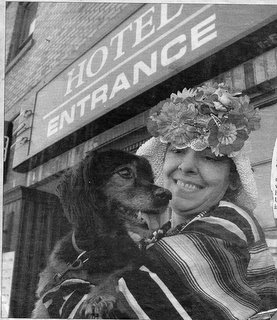 along with a “lite” story on the closing of the Inn and the fact that many of these people were without shelter as a result of the City’s actions. It did, and still does bother me, that no one seemed to spare a thought to these people’s fate. That none bothered to follow up to see what had happened to these people and to call the City to account for failing to act in an ethical manner.
Christina was thus to find herself on the streets of Abbotsford as the seasons turned to winter and the weather to a threat to life, unable to find the help needed to find a place to shelter – a home. Her home, her shelter against the elements became a tent pitched in a patch of woods or brush somewhere within the City. Some of these “homes” were actual tents donated from good samaritans, some were “tents” constructed from tarps or plastic sheeting. While all these shelters’ where inadequate dwellings for a human being, they permitted survival, keeping Christina alive. Sharp readers are correct; she went through numerous “homes”. Because, even as the City was in “see no homeless, hear not of the homeless, speak of no homeless” denial of reality mode, their enforcement officers where chasing Christina, and other homeless, out of their meagre shelter and placing them at the mercy of weather conditions. I am sure that even Christina lost count of just how many times she was driven into the deluge that fell last winter. It was hearing that once again the City, through its enforcers, was intending to harass Christina and drive her out of what poor shelter she had that led me to start to writing and protesting the senselessness, the pointlessness of this
behaviour.
This idiocy had previously occurred FIVE times to Christina. The compassionate citizens of Abbotsford giveth and the pitiless City taketh – everything: food, her shelter from the cold winter rains, warm, dry clothing and horded personal treasures with all their attached memories of life before she was reduced to depending on callous governments for survival. Caring city citizens donated items to their fellow citizens in dire need and their City, with callous disregard for the consequences to the homeless, turned their generosity into garbage. At the end of their fifth visit they also left the items they ruined littered about the floor of the woods, creating a massive eyesore. I am sure someone who is all knowing, but totally lacking any appreciation or experience with the hurdles faced by the homeless, about these “drug using, trouble causing bums” will essay that all Christina had to do was take her stuff with her. These same experts also appear to think that chasing the homeless from spot to spot around the city, when they have nowhere to in fact go, will accomplish something besides a total waste of the City’s resources. The donations of the generous souls of our city, while making an invaluable contributing to the survival and quality of life of the homeless, can also give rise to the dreaded “Shopping Cart Syndrome”. With no storage the homeless must carry their belongings with them or risk losing them. One can become as loaded as the proverbial pack mule, force to use the clichéd shopping cart to transport your belongings. I will not dwell upon, merely bring to the readers attention, just how lacking in panache hauling a shopping cart is for those of use with refined sensibilities.
It was following one of the destructive visits by city enforcers that Christina and other members of the homeless community sought shelter form the winter weather in an unoccupied building. It was here that tragedy struck. Forced to use open flame sources for warmth and cooking, fire is an ever present danger for the homeless. The building burned and Christina’s constant companion and friend, her small dog Buster, was killed. There is a group of school children who visit the Salvation Army Café, who knew Christina and felt her sadness. These kind souls gave her a little stuffed dog and an invitation to attend their Christmas concert, a concert Christina enjoyed greatly – almost as much as she appreciated the care and thoughtfulness of these young students. The great irony here is that if local or provincial governments were treating animals like Buster the same way they treat the marginalized and homeless they would be arrested and someone found to treat the animals with proper care. Unluckily for the homeless they are human beings and thus subject to what ever cruel treatment government chooses to inflict upon their bodies and spirits.
Abbotsford, like an ostrich, insisted on keeping its head buried so that it could avoid seeing the reality of its homeless citizens. Then CBC news reporter Belle Puri as part of the story about www.homelessinabbotsford.com, perhaps the only website in the entire world designed, built, written and maintained by a homeless person, approached the Mayor with questions about the homeless of the City of Abbotsford and why nothing was being done to address the issues associated with this growing need.
Mayor George Ferguson chose to LOOK, forcing many others to begin to see and think about the questions homelessness raises. The Mayor also chose to call a time-out in chasing the homeless around, and around, and around, and around the city, in order to give at least some thought to what would be an effective course of action. While this pause only spanned a period of six weeks, it did serve to make people aware of the issues and began a dialogue in the community on what needs doing. One can only hope that over time this dialogue will prove to be a case where actions speak louder than words. I feel that trying to put a label of successful or unsuccessful on the experience with “Camp Compassion” would be as pointless as chasing the homeless from spot to spot within the city. The value of the Camp lies in the lessons to be learned, several of value which can be learned from continuing with Christina’s tale.
For it was in that patch of woods that Christina had sought shelter. At the time that the “Camp” was birthed, Christina was among the longest residents of that particular patch of woods. For her, Mayor Ferguson’s time-out was the equivalent of a stay of execution as at that time she was once again being threatened and/or forced to move along. Although no-one would or could say exactly where it was she should move to. At any rate, just before the axe was due to fall the residents received a reprieve. During this period the Salvation Army received funding to experiment with “outreach workers”. When old ways of dealing or NOT-dealing with a problem have no useful outcomes it is time to seek new ideas and be willing to experiment in seeking positive outcomes. Understand that it was not that Christina had not been seeking a place to live, rather that it is much harder than most people appreciate for the homeless to find a place to rent even if they can overcome the barrier of the $325.00 shelter allowance. I also want to take the opportunity to make note of the fact that in an effort to help herself, Christina had taken and completed the Triangle Resources woman’s W.R.I.T.E. program to help her regain independence through employment.
It was a struggle against time for Christina to find a place to live within the six week window of opportunity she had. Her success was due to Z, an outreach worker with whom she formed a bond and whose help in finding a place, access to a phone, making the needed calls, getting to the building to view it and meet with those responsible for the building, getting references together for the rental application and many other small but needed tasks. Without Z Christina would be among those she now hears speaking of the police once again chasing the homeless from spot to spot. Importantly Z’s involvement with Christina was to continue. The ladies of Z’s church would help Christina with moving in a acquiring all the many things (dishes, pots, pans, toiletries, a bed etc) one requires to live inside. Christina had a friend to help her through the difficult transition from the outside to the inside. Believe me, that transition is far tougher than someone who has never had to make it (be extremely grateful for that grace) could understand. All the times you need to say NO in order that you do not slip back into bad habits and back out onto the streets. Having someone or somewhere to turn inn order to get through these weeks (or months) is imperative. Then it was time for Z to help Christina with employment. Christina is currently at “Above the Underground” an opportunity to gain knowledge and experience in the retail store sector. Z is there to help her get to work, provide positive feedback and support through the difficult times. Someone who is in for the long haul, who appreciates this process is not fast or easy, but is there to help you overcome the barriers. This need for a long term commitment, to constantly following up, to maintaining contact and support, for flexibility in the support services provided, the need for many varied types of help, the need for a case worker approach and the importance of this constant, continuing follow-up are some of the lessons to be learned. Perhaps one of the most important things to be learned is that we can help the homeless. It may need to be one at a time; it may well require individual programs; it may need to be one-on-one; it may require a large investment of time; we need to be proactive; it will require the support of the community. But we can do it what we need is the Will.
Christina is a work in progress, but them so are we all. With the help and support of people around her Christina is moving forward and getting on with life. Which is a success story by any measuring stick you chose to use.