Category Archives: The Issues

The Shadow of Hunger

A holy man was having a conversation with the Lord one day and said, ‘Lord, I would like to know what Heaven and Hell are like.’

The Lord led the holy man to two doors.

He opened one of the doors and the holy man looked in. In the middle of the room was a large round table. In the middle of the table was a large pot of stew, which smelled delicious and made the holy man’s mouth water. The people sitting around the table were thin and sickly. They appeared to be famished. They were holding spoons with very long handles that were strapped to their arms and each found it possible to reach into the pot of stew and take a spoonful. But because the handle was longer than their arms, they could not get the spoons back into their mouths.

The holy man shuddered at the sight of their misery and suffering.

The Lord said, ‘You have seen Hell.’

They went to the next room and opened the door. It was exactly the same as the first one. There was the large round table with the large pot of stew which made the holy man’s mouth water. The people were equipped with the same long-handled spoons, but here the people were well nourished and plump, laughing and talking. The holy man said, ‘I don’t understand.’

It is simple,’ said the Lord. ‘It requires but one skill. You see they have learned to feed each other, while the greedy think only of themselves.’

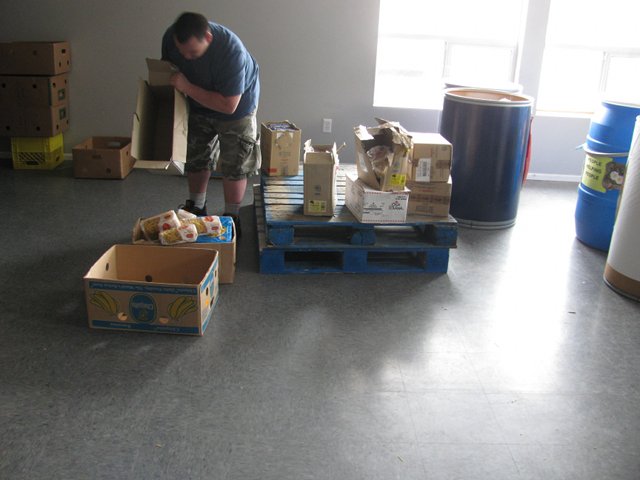
The shelves at the Abbotsford Food Bank are nearly bare. Yet the number of seniors, families and children who depend on the Food Bank grows.

July and August are traditionally the slowest months for donations to the food bank. This year, between the growing demand and the bare shelves, the Food Bank simply cannot afford this traditional downturn. Without generous help from the community, hunger will triumph this summer in our city.

Will you share your spoon with Abbotsford’s hungry?

The FACTS are …

Leaving aside, for the moment, the errors in fact contained in Mr. Johnson’s letter of June 15th am I to infer from his letter that if everyone was jumping off a bridge he would jump as well?

Mr. Johnson has every right to be fine with the Conservative government using the previous Liberal government in setting its ethical standards.

Just as I have the right to demand substantially higher ethical standards of behaviour from our federal Canadian government, rather than tolerating the lowest common denominator as the standard.

The fact is that the federal government should not be worrying about being ‘embarrassed’ over the issues of affordable housing and child poverty but about addressing these issues.

The fact is that, prior to Mr. Harper’s appointment of Mr. Braley, senate appointments had indeed been made to party faithful – as a reward for years of hard work on behalf of the party. Mr.Braley’s ‘faithful service’ was large financial contributions, a very different kettle of fish. Leaving one to draw the conclusion that under Mr. Harper a senator seat is the reward for substantial enough monetary contributions to the Party.

The fact is there is no requirement that forces the federal parliament to appoint senators on a specific timeline. Mr. Harper could have kept his promise not to appoint senators.

Instead, despite Mr. Harper’s repeated attacks on the previous Liberal government for appointing senators, as soon as the opportunity to appoint enough senators so that the Conservatives would control the Senate and could force legislation through without being troubled by any sober second thoughts Mr. Harper appointed those senators.

The fact is there was nothing for Mr. Harper to over-rule on the matter of pensions. When the day came that Mr. Harper and members of the Conservative caucus had to either a) opt into the golden pension parliamentarians have approved for themselves or b) opt out and never be eligible for said sweet, overly generous pensions Mr. Harper and the Conservatives scurried right up to pig-out at the public trough.

All Mr. Harper and the Conservatives had to do to remain true their own words on the matter of pensions was – just say NO. But when push came to shove and it would cost Mr. Harper and the other members of the Conservative caucus big pension $$$, expediency (and their pocketbooks) won out.

Mr. Johnson’s most significant factual error lies in his dismissal of ethics in his statement “We have far bigger problems than noted above …”

Ethics are a fundamental building block, perhaps THE fundamental building block, in a government, a country or a society. Without an ethical underpinning considerably higher than the lowest common denominator we are going to continue to get the government, country and society that the majority of Canadians are very dissatisfied with. Despite it being the government, country and society that we have, through our actions and choices – individually and collectively – built.

If we want to change the government, country and society for the better we need to start with a solid ethical foundation and not a set of ethics that is based on ‘everybody does it’.

The problem for so many is that setting one’s ethical standards based on high-principles and honourable behaviour often causes inconvenience, sometimes great inconvenience by denying one convenient, self-serving behaviours.

If you promise not to appoint senators then, even/particularly when politically convenient you don’t appoint senators. If you are going to attack MP pensions then when it is time to opt in or out you opt out – even if it is costly.

I make no apologies for feeling we need to hold our government, our country, our society and most of all ourselves to higher ethical standards in order to change the same old government, country and society everyone complains and bitches about into the government, country and society Canadians want.

School Boards

Responsibility? Accountability?

Watching the Tuesday June 8th news reports concerning the situation the Vancouver School Board finds itself in, the behavior and statements of board chairwoman Patti Bacchus brought several thoughts to mind.

I found Ms Bacchus’s statement that her and the board’s top three priorities were funding, funding, funding appalling and rather disheartening. One can only hope Ms Bacchus’s claim that funding, funding, funding were the top three priorities or concerns of all other school boards in BC was only further hyperbolism.

The number one priority of any school board or school board member should be the students, their welfare and education.

And no Ms Bacchus they are not the same thing. The welfare and education of the students is a far different, far more important matter than funding.

Watching Ms Bacchus’s cavalier dismissal of the report of the Comptroller General, finger pointing at the provincial government and tantrum like insistence on having her own way I was struck by the lack of either responsibility or accountability on the part of the school boards in BC.

I would like to suggest that the province act to remedy this lack of accountability and the ability of school boards to accept responsibility for their decisions and actions.

It is important to preserve the current system of provincial funding for students in order to provide a level as possible system for all students in the public school system.

However there should be put in place the ability of school boards to levy additional funds from the community.

In this way school boards that found themselves unable to live within their budgeted means would have the ability to raise additional funds from their community.

The boards would then be able to cover shortfalls but would be responsible and accountable to their local communities for their fiscal and budgetary decisions at the next school board elections.

There could be, or is that would be, a temptation on the part of the provincial government to try to download education costs. Responsibility and accountability for those behaviors would, in the same manner of the school boards, be assessed, judgments made and sanctions applied by the voters.

Whether it is through the ability of local school boards to raise extra funds or not, it is becoming clear that in the world of limited funds available to the different levels of government (municipal, provincial, or federal) to meet their commitments with, we need to ensure that those responsible for spending large amounts of those funds are, at least to some degree, held responsible and accountable for the manner in which they spend voters dollars.

Explains a Lot.

Watching the histrionics of school boards, parents seeking to save schools or programs from closing and the Minister of Education clearly explains why our schools are failing to provide students with a cogent education.

Education is supposed to develop the ability of students to think, teach students how to learn, to impart knowledge and to prepare students so that the transition from school to the real world does not overwhelm them.

Given the demonstrated lack of basic business mathematical skills; the displayed absence of even a rudimentary understanding of the fundamentals of finance and budgeting; the indication of an unwillingness to accept responsibility or act in a dutiful manner; the fundamental shortfall of leadership and this populace’s direct affect on education – there should be no mystery as to why many citizens feel students are not being provided an adequately cogent education.

To demonstrate responsible behaviour and leadership homelessinabbotsford.com will be providing a series of experimental, real world lessons to teach those cited in the opening paragraph, politicians, those who signed the HST petition and decidedly the media about basic business mathematics, budgeting, financial and fiscal realities.

Lesson One.

Get a piece of lined paper and copy down these instructions at the top of the page; place a line or lines to separate the instructions from the rest of the page.

Get a toonie – the Canadian $2 coin or its equivalent in coin (coins totaling 200 cents).

Go to a store, taking the written instructions with you (with a writing instrument) and select $3 worth of merchandise – for simplicity the cost of the merchandise can fall anywhere in the range of $2.75 – $3.25.

Take the merchandise selected to the checkout and proffer the toonie (or its equivalent in coin) as payment for the merchandise selected.

In the separated second section of the page that contains the instructions, carefully note the outcome of this offer of exchange and any interactions and comments offered by the clerk.

Upon returning home get a second, blank lined page. Looking at the original page examine the instructions and what occurred at the checkout and consider why what took place at the checkout occurred.

On the second sheet of paper write down any hypothesis you arrive at as to why what occurred took place. Make note of any mathematical or financial truths or realities that were demonstrated by this exercise. See if you can ascertain any general business, mathematical or financial rules that would apply in the broader world of fiscal reality.

Our second lesson will contain a review of the outcomes, what knowledge was available to be gleamed from this experiment and provide the next experimental lesson.