Category Archives: Issues

Panhandlers curbed in Abbotsford

Screamed the eye catching headline on the front page of the Abbotsford News Friday April 6 2012 edition. A headline that enticed me into reading the article, which brought to mind some thoughts on the clarification that currently manifests on the Abbotsford Today website.

It would seem to me that if Black Press is concerned about inferences being drawn (or suggested) that The News is bias in favour of or had lost objectivity about the City of Abbotsford as a result of undue influence resulting from a) the City of Abbotsford spends all its advertising dollars in the Abbotsford News which, if it doesn’t make the City the newspaper’s the #1 advertiser, makes it a crucial contributor to the health of the bottom-line and b) it is the City, where advertising is not affected by the economy or the competence of management, which would multiply the extent to which these advertising dollars are indispensible to the financial health and/or continued existence of The News, The News should simply focus on consistently demonstrating “The Abbotsford News … long history of independence and integrity with respect to its editorial content

This does not mean I expect or demand The News to agree with me and disagree with the City’s actions, claims or view point. I too am “acutely aware of the fundamental importance of freedom of expression and freedom of the press…” for organizations as well as people. I consider public discussion and debate of issues to be vital to good governance. Indeed, given the current economic and financial realities of all levels of government discussion and debate is imperative if the voters are to have a say in the direction of our economy and our financial futures.

No, all that is required for the News to demonstrate their commitment to the “… long history of independence and integrity with respect to its editorial content” is to provide an explanation and cite reasons and evidence as to why the News supports a particular action or position. In the same manner as do I and others when we feel the behaviour, actions or positions of Abbotsford City Council are not only less than wise, but financially irresponsible, even ruinous.

The News has every right, a right I would defend, to think the young athletes of Abbotsford should be helping to subsidize professional athletes. The News simply needs to provide an explanation and cite reasons or evidence to as to why they have take the position they have..

For example: I feel that if any subsidizing of sports occurs in Abbotsford it should be directed to the youth and young athletes of Abbotsford, not professional hockey players. The chief reasons that I feel this way are the Canadian Government studies that show a) kids today have a shorter life expectancy than their parents (meaning that for the first time in generations life expectancy is going down not up) and b) kids today are falling far short of the hour of exercise per day they require for healthy living.

So what are the reasons, the evidence that has The News supporting the subsidizing of professional athletes?

It does not seem unreasonable to ask that The News explain and cite reasons and evidence  as to why they support actions taken by Abbotsford City Council. It would also be beneficial to addressing any questions of City influence or independence if The News were to ask/address the obvious questions about issues and situations that any reasonable person would, as well as take any obvious actions associated with articles, the position and coverage by the News.

Which brings us back to the question of panhandling and why an article on panhandling led to thoughts on the clarification on Abbotsford Today’s website..

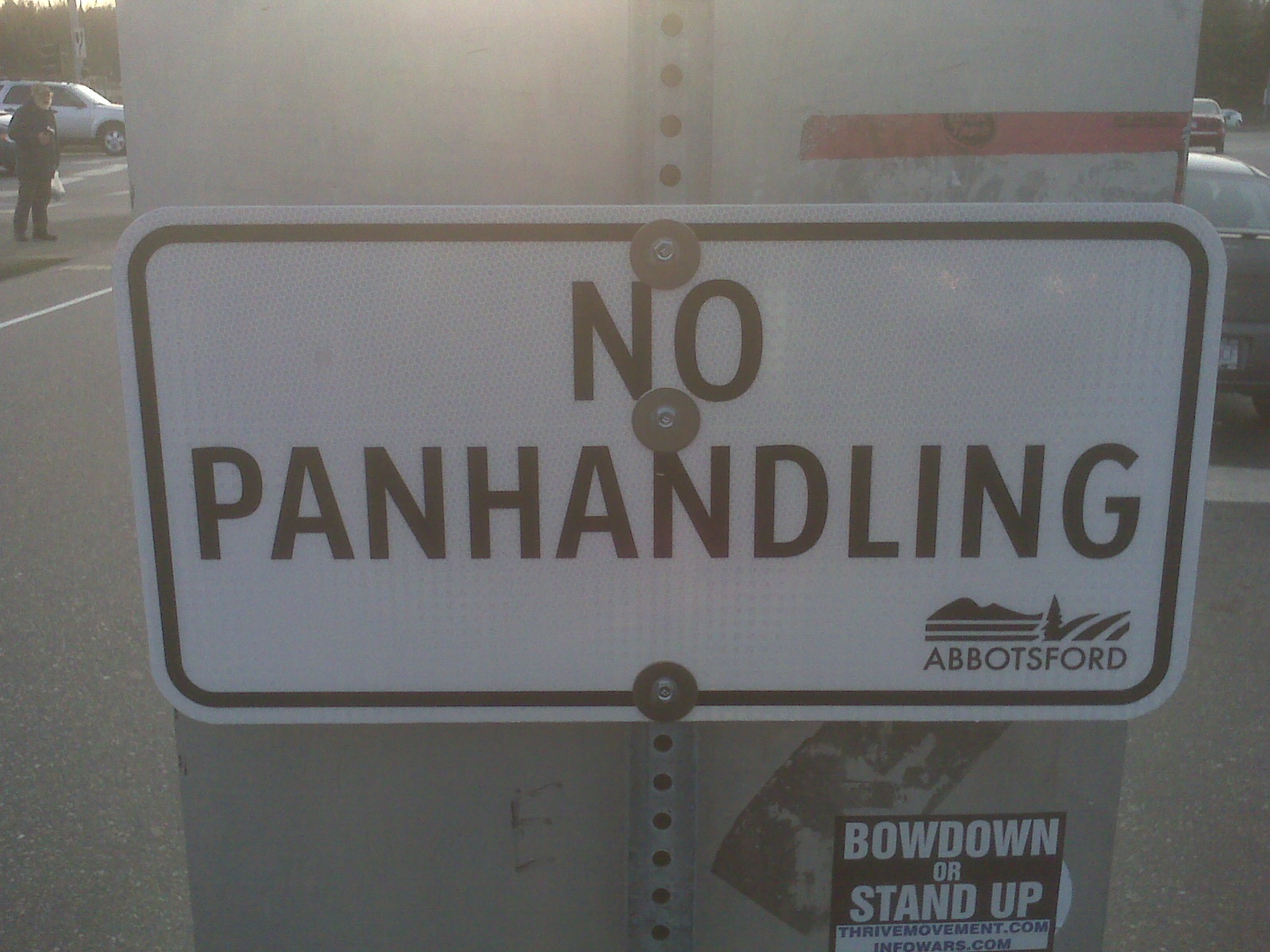
Right across the street from The News building one would find one of the new No Panhandling signs touted by the City in The News front page story.

CITY COUNCIL’S SOLUTION

I would think it only reasonable that those who are responsible for the content of The News to cast an eye across the street and see how City Council’s panhandling solution was working.

It is taking simple actions such as looking through a window and applying some thought to matters that has led many citizens to consider it wise to question the efficacy of City Staff and Council’s actions.

REALITY

Except of course the squandering of millions of taxpayer’s dollars, behaviour Staff and Council have demonstrated complete mastery of.

Harm Reduction

Reading Simon Gibson’s recent comments on harm reduction had me wondering if someone ought to inform Mr Gibson that ‘I used to have an open mind but my brains kept falling out’ is a Joke, not a statement of reality.

Change is uncomfortable, conspicuously so in instances necessitating changing one’s mind.

It is far more comfortable, far more the usual human way, to let inertia keep us bogged down in what we know – no matter how inaccurate that ‘knowledge’ is.

“Gibson said he worries Abbotsford could end up being a centre for drug treatment programs that support continued addiction without addressing the deeper problem.”

If Abbotsford council were to repeal the bylaw there would be NO flood of people into Abbotsford. For the simple reason that harm reduction is part of healthcare everywhere in BC except Abbotsford, and since people everywhere else in BC already have access to these services they have no need to come to Abbotsford.

While the health of Abbotsford’s citizens should be of concern to Abbotsford City Council, council’s actions make it clear the health of Abbotsford’s citizens is not a matter of concern to council, at least not in the manner an Arena or professional hockey team or paying million dollars subsidies are..

Still, City Council’s anti-harm reduction bylaw is consistent with Council’s policy of profligate mismanagement of taxpayer dollars. Because of the bylaw, dollars for Fraser Health programs containing even the tiniest amount of harm reduction are spent in every Fraser Health community BUT Abbotsford.

“Needle exchange, safe injection sites and free-standing methadone clinics will perhaps be desirable for some addicts but without a full detox facility, they could almost certainly create an environment of social acceptance [for drug addiction],” said Gibson.

Hmmm. I had not realized that there was an environment of social acceptance of alcoholism – despite alcohol being legal. I was also under the impression that cigarettes being legal did not preserved the environment of social acceptance that existed prior to public knowledge of the serious negative health consequences of smoking. Nor did legal status stop the development of an environment of social disapproval/non-acceptance of smoking.

Leaving me wondering how Mr Gibson could conclude that heath care services to address the serious negative health consequences of addiction would in any way encourage social acceptance?

Indeed, would not a focus by the health authorities on the negative health consequences of drug use serve to decrease social acceptance of drug use?
Would not a public focus by the health authorities on the serious negative health consequences discourage drug use period?

Harm reduction could act as a disincentive for addicts to seek treatment, he [Simon Gibson] added“

The evidence makes it clear that drug users involved with harm reduction programs such as Insite get into treatment faster. I know it seems counterintuitive, but then substance use is a people issue and people are contrary.

The reality that substance users involved with harm reduction programs seek recovery and wellness sooner is why David Portesi, director of public health for Fraser Health, stated.

“[The bylaw] drives clean needle distribution into the shadows, increases the value of used needles on the street and increases the risk of HIV and Hep C infection.”

“And at the same time, it reduces our ability to engage users in treatment discussions.”

This outcome, people seeking recovery and wellness faster with harm reduction, is consistent with the fact that stable, safe, supportive housing results in people seeking recovery and wellness sooner.

Councillor Gibson went on to state “Harm reduction will do little to make Abbotsford a safer and more secure community.”

It doesn’t really matter whether the above statement arises from philistinism or from the wilful ignorance of a closed mind, sealed tight to prevent a single new thought entering and disturbing the mind. What matters is the blindness reflected in the statement and the negative consequences for ALL citizens of Abbotsford.

Harm reduction is not about drug treatment programs it is about healthcare – for the individual substance users/abusers and the other members of the community the users/abusers live in.

The women selling themselves for money for drugs depend on upstanding citizens purchasing sex because those good citizens are the ones with the money they need to feed their addiction.

Have you seen the advertisement for the vaccination against Hepatitis A & B if you are travelling? An advertisement that uses how easy it is to be infected with Hepatitis A or B to scare you into using their product? You don’t have to go to a foreign country to get infected with Hepatitis A or B.

This sobering reality is why I was/am sure to be vaccinated against Hep A & B.

Unfortunately there are no vaccinations for Hepatitis C or AIDS.\

Should you suggest that perhaps we should build some housing for these vulnerable members of our community, given the clear evidence that providing housing gets people into treatment quicker and supports them staying in recovery instead of relapsing, the wringing of hands and gnashing of teeth over needles, needles, needles begins.

Given the litany of citizens worries about dirty needles and the potential negative health consequences of dirty needles, how does council justify refusing to allow programs that reduce the number of dirty needles left lying about?

Negative health consequences do not discriminate, do not play favourites, their nature is to spread everywhere they can.

I suppose it is only to be expected that Councillor Gibson and council gave no thought to the fact that their bylaw would negatively impact healthcare in Abbotsford. Or that Councillor Gibson sees no benefit in council no longer interfering with the providing of healthcare to Abbotsford’s citizens.

“Harm reduction will do little to make Abbotsford a safer and more secure community.”

I am driven to abjure any association with the above statement.

The indifference to, the callous disregard for, the state of our fellow citizens, the wellness of our neighbours, evidenced by that statement is anathema.

‘If there ain’t nothing in it for me, then there ain’t no reason for me to care or be benevolent or have concern for the welfare of my neighbour’

While it is not easy, is in fact most times a struggle, both ethics and spirituality mandate an approach to those abusing substances (of any description) based on:

‘………….. The second is this, ‘You shall love your neighbour as yourself.’

Rules? There are Rules?

I was at a meeting focusing on shelter needs in Abbotsford, what the shelter needs of Abbotsford are, whether the shelter needs are being met (are there gaps in shelter services) and what can be done to cover any gaps.

Some members of the homeless community became aware of this meeting and felt their interests needed to represented and protected from any negative consequences resulting from this meeting.

So I found myself attending the meetings to represent one subset of the homeless/addiction/mental illness/poverty community who have concerns about their needs, wants and priorities being misrepresented by another subset of the homeless/addiction/mental illness/poverty community who present their concerns as those of the entire community; when in fact the concerns being discussed at the meeting represent only the point of view of one group whose voice is loud because they have organized and named themselves

At these and other meetings around Abbotsford, claims have been made as to what happens in the shelter. As someone who works at the shelter, who has been a client and who discusses the shelter with clients regularly there are a few comments I would like to share as to the veracity of those claims.

Despite repeated claims to the contrary, during extreme weather nobody is turned away for any reason.

However if someone’s behaviour is threatening to other clients in the shelter or staff; if someone’s behaviour is extremely, extremely disruptive and interfering with other clients in the shelter they will be asked to leave.

Being removed from the shelter occurs only after clients have been warned (repeatedly) that they need to modify their behaviour and then only after having been given the choice of going to bed or leaving.

It is also repeatedly claimed that nobody knows what the shelter rules are, yet these same clients demonstrate a grasp of any rules they want to take advantage of.

Everyone staying at the shelter fills out a registration form on the back of which the rules are listed. Clients are instructed to fill out the registration, read the rules, if they have any questions about the rules to ask staff and the rules will be explained; if they understand the rules or once they do understand the rules they sign the registration form to acknowledge they provided the information on the registration form and have read and understand the rules.

During my visits to the shelter as a client I had no trouble knowing the rules – I simply turned the registration form over and read the rules.

I suppose we could ensure the clients have read and studied the rules by giving a quiz about the rules and turning people away if they failed the quiz. But then everyone would be complaining about being forced to study the rules.

In order to address the reality that many clients do not read the rules (thus permitting clients to claim they didn’t know and/or were never told the rules when they violate rules) the rules are read aloud before the shelter opens for intake.

I do not want to give the impression that all, or even most, clients are rule challenged. Other clients demonstrate an ability to either read the rules on the back of the registration form; listen, hear and comprehend the rules read aloud every night to clients before the shelter is opened; ask for clarification of the rules “can I ….” Or “what happens if……or “how would I……”

I have long lost count of the number of clients who repeatedly claim not to know a rule (or rules) you have specifically discussed with them before or repeatedly before – sometimes mere minutes before. Or clients who are overheard laughingly telling other clients about ‘almost getting caught’ smoking pot, crack, drinking or disobeying some rule. Who acknowledge knowing their behaviour violates the rules, but then explain why the rule does not or should not apply to them; or who argue the rule is a stupid rule, should not be a rule and thus they do not have to abide by the rule(s). Or had incorrectly assumed they would not get caught and would get away with ignoring the rule(s). Or – the #1 favourite excuse – claim not to have known the rule(s).

When the latest Cold Wet Weather status ended someone who was over their nights and needed to wait 30 days before getting their next 5 nights in the shelter was standing there protesting they did not know about only having 5 nights, even though they had been on a plan (he was no longer on a plan because he had not kept the terms agreed to in order to remain on his plan).

On Sunday nights staff make sure to remind those who are on night 4 or 5 that if they need more than the 5 nights they need to sign up and see Case Management Monday. For those whose fifth night was Saturday night, we grant a grace night and remind them that they must talk to Case Management to get more nights or wait 30 days for their next 5 nights. The shelter at large is reminded several times throughout the evening that those needing more than 5 days need to see Case Management to get more than 5 days.

Case managers always remind clients that they need to do what they agreed to do as their plan and be at the shelter gate when the shelter opens at 6 pm. To provide motivation case management reminds clients that they need to carry through on these points because they have used up their five nights and if they are not at the shelter at the 6 pm opening time or they do not carry through with the actions they promised to perform, they are off their plan and will need to wait the 30 days until they get a new 5 nights.

And claiming you do not know about the 5 night rule is not going to work very well when you are making that claim to a staff member who had made sure to warn you that you had been given a grace night so that you could talk to Case Management on Monday morning if you needed more nights because you had used your 5 nights up on Saturday night.

Most ignorance is evincible ignorance. We don’t know because we don’t want to.  Aldous Huxley

While on the subject of rules, just how detailed do the rules need to be? Does every little detail need to be spelled out? What about a little common sense (which is admittedly not so very common)?

Is it really necessary to spell out that standing in the middle of the shelter screaming at the top of your lungs is unacceptable behaviour? Or that you need to take a shower and have your clothes washed when the odour you emit renders the air of any room you are in non-breathable? (The shelter provides sweats for those with only the clothes they are wearing – at least as long as loaner clothing can be replaced faster than it is being stolen). Or that Smoking pot or crack or consuming alcohol is not permitted?  Or that if you need to urinate you use the washroom, not the corner of the room or another client and their bedding or a garbage pail or a cup? Is it really that hard to understand what a sign marked ‘Staff Only’ means?

And whatever happened to Personal Responsibility?

Homelessness/addiction/mental illness/poverty does present people with barriers, problems and issues. It does not absolve them of personal responsibility for their behaviour.

On a bad head day, the fact mental illness has me wanting to scream, act out or strike out at others is not an excuse or permission to do so.

I and many others who accept personal responsibility for our actions have (or had) no difficulty with the shelter rules or staff. Of course we also acknowledge that we are not ‘special’, that the rules apply to us as well as to others.

Some claim others get treated better than they do. But why would anyone be surprised that being polite, saying please and thank you, gets a friendly response while screaming, cursing and verbal abuse gets a less positive response?

Then there are the clients who complain they are ‘picked on’ when they keep repeating the same self-defeating behaviour and end up under review for repeating their behaviour time after time after time.

Should you mention AA’s “if you are happy getting what you are getting, keep doing what you are doing; if you are not happy getting what you are getting, stop doing what you are doing” daring to suggest they need to change their behaviour to get different outcomes – you are cursed at and heaped with verbal abuse for suggesting they accept any responsibility for their behaviour.

Listening to what is said (is claimed) in these meetings about what occurs at Abbotsford’s shelter, gives one the impression that running a shelter is easy. It is not.

Abbotsford’s shelter is in space adapted for, not built for, use as a shelter. Langley’s shelter space was built for the purpose of being a shelter so when clients come in their belongings and clothing are put in a locker and they wear clothing provided by the shelter – ensuring nothing comes into the shelter, that the clients have nothing with them that is not provided by the shelter.

Ensuring staff in Langley do not run the risk, that Abbotsford staff face, of getting stuck by needles carelessly discarded or thoughtlessly left in clothing put into their laundry bags; laundry that is done by staff as a service so clients have clean clothing.

The risk, the close calls that occur, of getting stuck with a client’s used needle from a population infected with Hep C, AIDS, hepatitis A & B et al. As if  it is not enough staff gets lied to, verbally abused and screamed at; has to deal with people who are drunk or have used another substance to achieve an altered state of reality; deal with clients who, based on demands and actions, are under the impression they are more important than all the other clients in the shelter or that they are in a 5 star hotel, not an emergency shelter; get to clean up puke, urine, shit, blood; have to exercise patience, understanding, tolerance and judgement – or the shelter would slowly empty of clients in the hours following intake.

When a shelter opened in a neighbouring community several years ago the new shelter was going to show the staff at Abbotsford’s shelter how a proper shelter was run. This shelter now has more rules and people under review than Abbotsford.

The reality is that it is far, far easier to run or work at a shelter in theory than it is in a shelter in the real world, a wolrd populated with real people.